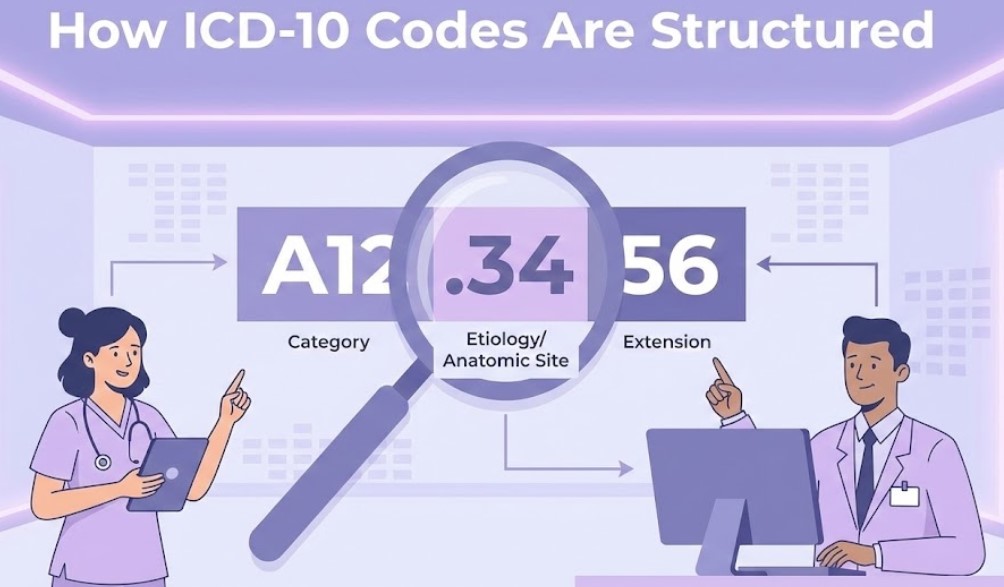
Navigating the world of medical coding can feel overwhelming, especially with a system as detailed as ICD-10-CM. While it has been the standard since 2015, its complexity can still cause confusion. The good news is that the code structure itself is logical and follows a consistent pattern.
By breaking down an ICD-10 code into its parts, it becomes much easier to understand. Let’s explore this structure piece by piece.
The Basic Building Blocks of an ICD-10 Code
An ICD-10 code can be anywhere from three to seven characters long. The first character is always a letter, while the characters that follow can be either letters or numbers. As a rule, the longer the code, the more specific the diagnosis.
To illustrate, let’s use a common example: S86.011A – Strain of right Achilles tendon, initial encounter.
The structure of this code can be broken down as follows:
|
Code Segment
|
Characters
|
What It Represents
|
Example Breakdown
|
|
Category
|
1st – 3rd
|
The general group of the disease or injury.
|
S86 = Injury of muscle, fascia and tendon at lower leg
|
|
Etiology & Specifics
|
4th – 6th
|
The cause, exact anatomy, severity, and other clinical details.
|
.011 = Strain of right Achilles tendon
|
|
Extension
|
7th
|
The type of encounter for treatment and recovery.
|
A = Initial Encounter
|
1. The Category (First Three Characters)
The first three characters define the code’s category. In our example, the letter “S” indicates the chapter for “Injuries, poisoning and certain other consequences of external causes.” The full category S86 specifically means “Injury of muscle, fascia and tendon at lower leg.” If a condition doesn’t have a more specific code, a three-character category can sometimes be used on its own.
2. The Clinical Details (Fourth, Fifth, and Sixth Characters)
These characters add vital layers of detail. They specify the exact diagnosis, the affected body part, and laterality (right, left, or bilateral). In our case, .011 pinpoints the injury as a “Strain of the right Achilles tendon.” This is where the code moves from a general category to a precise medical description.
3. The Seventh Character (Extension)
This is a crucial character for certain codes, primarily in the Injury and Pregnancy chapters. It describes the stage of care and must always be in the seventh position. If a code has only five characters but needs a seventh, a placeholder X is used to fill the sixth spot.
Common seventh character extensions for injuries include:
- A – Initial Encounter: Used for the entire period of active treatment (e.g., emergency care, surgery, initial PT evaluation).
- D – Subsequent Encounter: Used for routine care after the active treatment phase, during healing or rehabilitation (e.g., follow-up visits, physical therapy sessions).
- S – Sequela: Used for complications or chronic conditions that arise as a direct result of an initial injury (e.g., chronic pain or a scar from an old burn).
In our example, A correctly signifies that this is the patient’s first visit for this specific strain.
When One Condition Requires Multiple Codes
For a complete clinical picture, you often need more than one code.
- Combination Codes: A single code that describes two conditions that frequently occur together.
- External Cause Codes: For injuries, you can use additional codes from Chapter 20 (External Causes of Morbidity) to describe how, where, and why the injury happened.
Let’s return to our patient with the Achilles strain. The story is that it happened while running on a treadmill at a local gym. To fully code this, you would need:
- The Injury Code: S86.011A (Strain of right Achilles tendon, initial encounter)
- The Activity Code: Y93.A1 (Activity, running)
- The Place of Occurrence Code: Y92.39 (Gymnasium as the place of occurrence)
- The External Cause Status Code: Y99.8 (Recreational activity)
This set of four codes provides a comprehensive and accurate story of the patient’s condition and its cause.
Conclusion
While ICD-10-CM is detailed, its structure is logical and consistent. Understanding this “anatomy of a code” helps demystify the process, leading to more accurate documentation, better patient records, and smoother billing. This level of specificity is ultimately a powerful tool for capturing the true nature of a patient’s health condition.
Read More ICD-10 Related Articles: