In the intricate world of healthcare documentation, accurate medical coding is the universal language that ensures clear communication between providers, payers, and public health authorities.
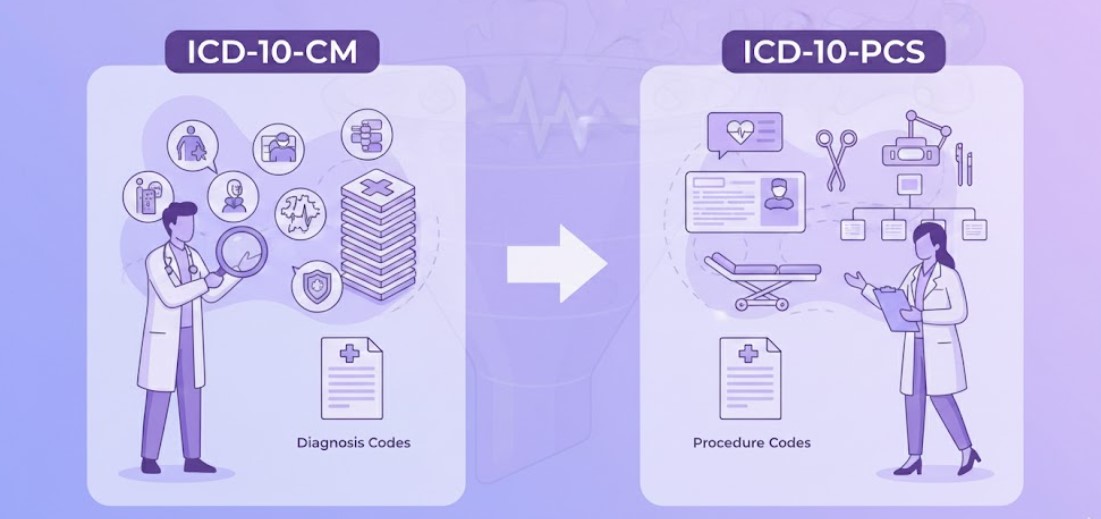
In the United States, this language is built upon two distinct but complementary systems: ICD-10-CM and ICD-10-PCS. While their names are similar, their purposes, structures, and applications are fundamentally different. Understanding this key distinction in medical coding is crucial for anyone involved in patient care, medical billing, or health data analysis.
This article will clarify the critical differences between these two coding systems, providing a clear guide to their unique roles in the healthcare landscape.
ICD-10-CM | The Standard for Diagnosis Coding
The International Classification of Diseases, Tenth Revision, Clinical Modification (ICD-10-CM) is the standardized system used for diagnosis coding. It classifies patient diseases, symptoms, and reasons for encounters across the entire U.S. healthcare system.
Developed by the Centers for Disease Control and Prevention’s (CDC) National Center for Health Statistics (NCHS), ICD-10-CM is a clinical modification of the World Health Organization’s (WHO) ICD-10. Its primary function is to answer the question: “Why did the patient seek care?”
- Scope of Use: ICD-10-CM is used in all healthcare settings, including inpatient and outpatient hospitals, physician offices, clinics, and emergency departments. This makes it the universal language for diagnosis reporting.
- Code Structure: ICD-10-CM codes are alphanumeric and range from 3 to 7 characters in length. The structure provides specificity for factors like disease severity, laterality (right vs. left), and whether the encounter is initial or subsequent. For a deeper dive into this structure, you can explore this guide on how ICD-10 codes are structured.
ICD-10-PCS | The System for Inpatient Procedure Coding
The International Classification of Diseases, Tenth Revision, Procedure Coding System (ICD-10-PCS) is used exclusively for procedure coding performed in a hospital inpatient setting.
Unlike ICD-10-CM, ICD-10-PCS was developed and is maintained solely in the United States by the Centers for Medicare & Medicaid Services (CMS). It was designed to replace the outdated procedural codes of ICD-9 and answers the question: “What was done to the inpatient?”
- Scope of Use: ICD-10-PCS is mandatory only for inpatient hospital coding of procedures. It is not used in outpatient or office settings, making its application highly specific.
- Code Structure: This system is highly structured and consistent. Every ICD-10-PCS code is exactly 7 characters long, and each character has a specific meaning related to the procedure, such as the body part, surgical approach, and device used. This granularity allows for precise tracking of inpatient care.
ICD 10 PCS vs CM
The table below summarizes the core distinctions between these two systems, highlighting the difference between CM and PCS:
Feature | ICD-10-CM (Diagnosis Coding) | ICD-10-PCS (Procedure Coding) |
Purpose | Classifies diseases, diagnoses, symptoms, and reasons for encounters | Classifies procedures performed in an inpatient setting |
Place of Use | All healthcare settings (inpatient, outpatient, doctor’s office) | Inpatient hospital settings only |
Code Structure | 3 to 7 alphanumeric characters; length varies | Always 7 alphanumeric characters; length is fixed |
U.S. Developer/Owner | CDC/National Center for Health Statistics (NCHS) | Centers for Medicare & Medicaid Services (CMS) |
Origin | Modification of the WHO’s ICD-10 | Entirely new system developed in the U.S., not based on WHO ICD-10 |
Specificity | Provides detail on laterality, severity, and encounter type | Provides detail on approach, device, and technique |
Why the Distinction Matters in Practice
For healthcare professionals, the practical implications of these differences are significant. A clinician in an outpatient clinic will only use ICD-10-CM codes to document diagnoses. In contrast, a medical coder in a hospital must be proficient in both systems: using ICD-10-CM to describe the patient’s conditions and ICD-10-PCS to detail the specific inpatient procedures performed, such as a right knee joint replacement.
Furthermore, the transition to ICD-10 from the previous ICD-9 system dramatically increased the number of available codes, allowing for much greater specificity in describing both what is wrong with a patient and exactly what was done to treat them. When navigating this expanded code set, understanding The 3 Key Criteria for Filtering ICD-10 Codes becomes an essential skill for efficiency and accuracy.
Official Resources
For the most accurate and up-to-date information, always refer to the official sources:
- ICD-10-CM: The CDC’s free browser tool is the official resource for diagnosis codes.
- ICD-10-PCS: The CMS ICD-10 website provides files and resources for the procedure coding system.
In conclusion, ICD-10-CM and ICD-10-PCS are two halves of a complete U.S. medical coding system. One tells the patient’s story through their diagnoses, while the other records the hospital’s actions through inpatient procedures. Mastering their distinct roles is fundamental to ensuring accurate documentation, appropriate reimbursement, and reliable healthcare data that drives quality patient care and public health insight.
Read More ICD-10 Related Articles: