

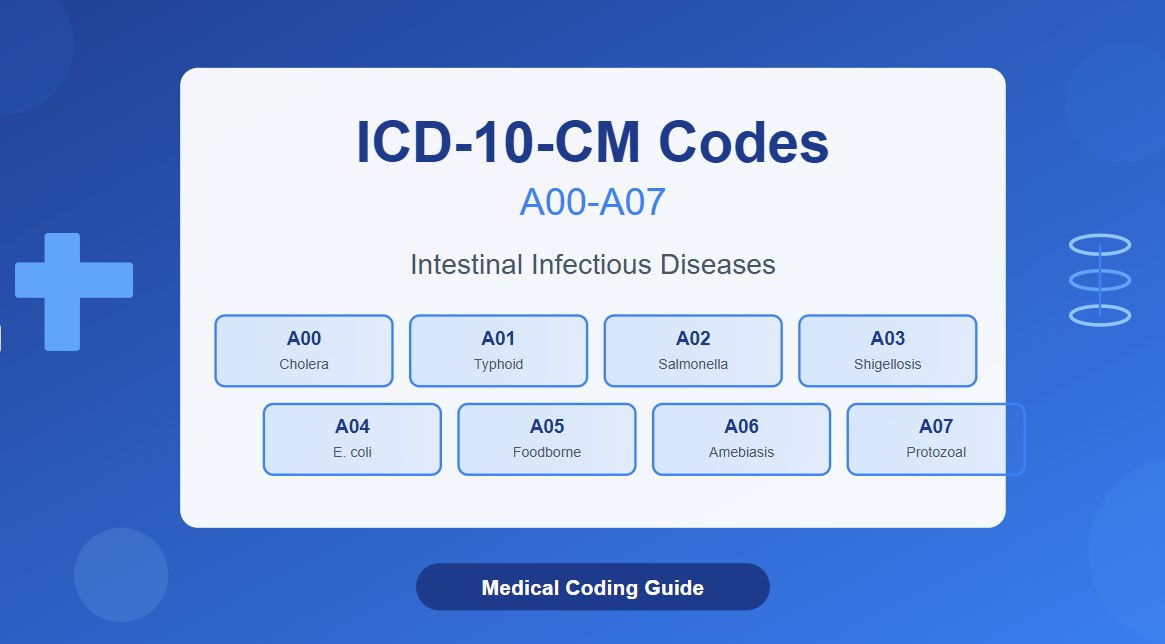
This comprehensive guide covers ICD-10-CM codes A00-A07 for intestinal infectious diseases, essential for accurate medical billing and clinical documentation.
Healthcare professionals and medical coders will find detailed tables covering bacterial infections (cholera, typhoid, salmonella, shigellosis, E. coli, C. difficile), foodborne intoxications, and protozoal diseases (amebiasis, giardiasis, cryptosporidiosis).
Each section includes an overview table of main categories followed by detailed breakdown tables with specific subcodes, diagnostic descriptions, and clinical criteria for proper code assignment and reimbursement.
| Code | Condition | Description |
|---|---|---|
| A00 | Cholera | A severe diarrheal disease caused by Vibrio cholerae, often from contaminated water. |
| A01 | Typhoid and paratyphoid fevers | Acute systemic infections caused by Salmonella typhi and paratyphi. |
| A02 | Other salmonella infections | Gastrointestinal or systemic infections resulting from non-typhoidal Salmonella. |
| A03 | Shigellosis | An infection of the intestines caused by Shigella, leading to dysentery. |
| A04 | Other bacterial intestinal infections | Various intestinal infections caused by bacteria other than Salmonella or Shigella. |
| A05 | Other bacterial foodborne intoxications, NEC | Food poisoning due to bacterial toxins not classified elsewhere. |
| A06 | Amebiasis | Intestinal or extra-intestinal infection caused by Entamoeba histolytica. |
| A07 | Other protozoal intestinal diseases | Intestinal infections caused by protozoa other than amebas. |
| Code | Name | Description |
|---|---|---|
| A00.0 | Cholera due to Vibrio cholerae 01, biovar cholerae | Cholera caused by the classical biotype of Vibrio cholerae O1. |
| A00.1 | Cholera due to Vibrio cholerae 01, biovar eltor | Cholera caused by the El Tor biotype of Vibrio cholerae O1, commonly linked to modern outbreaks. |
| A00.9 | Cholera, unspecified | Cholera infection where the specific biotype is not identified in medical records. |
| Code | Name | Description |
|---|---|---|
| A01.0 | Typhoid fever | Infection caused by Salmonella typhi. |
| A01.00 | Typhoid fever, unspecified | Typhoid fever where details are not specified. |
| A01.01 | Typhoid meningitis | Typhoid fever with inflammation of the brain and spinal cord lining. |
| A01.02 | Typhoid fever with heart involvement | Typhoid infection affecting the heart. |
| A01.03 | Typhoid pneumonia | Lung infection caused by typhoid fever. |
| A01.04 | Typhoid arthritis | Joint inflammation due to typhoid fever. |
| A01.05 | Typhoid osteomyelitis | Bone infection caused by typhoid fever. |
| A01.09 | Typhoid fever with other complications | Typhoid infection with additional specified complications. |
| A01.1 | Paratyphoid fever A | Infection caused by Salmonella paratyphi A. |
| A01.2 | Paratyphoid fever B | Infection caused by Salmonella paratyphi B. |
| A01.3 | Paratyphoid fever C | Infection caused by Salmonella paratyphi C. |
| A01.4 | Paratyphoid fever, unspecified | Paratyphoid fever where the type is not specified. |
| Code | Name | Description |
|---|---|---|
| A02.0 | Salmonella enteritis | Infection causing inflammation of the intestines due to Salmonella. |
| A02.1 | Salmonella sepsis | A severe body-wide infection where Salmonella enters the bloodstream. |
| A02.2 | Localized salmonella infections | Salmonella infection affecting a specific part of the body. |
| A02.20 | Localized salmonella infection, unspecified | Localized Salmonella infection with no specific site identified. |
| A02.21 | Salmonella meningitis | Inflammation of the brain and spinal cord lining caused by Salmonella. |
| A02.22 | Salmonella pneumonia | Lung infection caused by Salmonella bacteria. |
| A02.23 | Salmonella arthritis | Joint inflammation resulting from Salmonella infection. |
| A02.24 | Salmonella osteomyelitis | Bone infection caused by Salmonella. |
| A02.25 | Salmonella pyelonephritis | Kidney infection due to Salmonella bacteria. |
| A02.29 | Salmonella with other localized infection | Salmonella infection affecting other specific body sites not listed separately. |
| A02.8 | Other specified salmonella infections | Salmonella infections that are defined but not included in other categories. |
| A02.9 | Salmonella infection, unspecified | Salmonella infection where the exact type or location is not specified. |
| Code | Name | Description |
|---|---|---|
| A03.0 | Shigellosis due to Shigella dysenteriae | Severe form of shigellosis often causing bloody diarrhea and dehydration. |
| A03.1 | Shigellosis due to Shigella flexneri | Common cause of shigellosis, especially in developing countries. |
| A03.2 | Shigellosis due to Shigella boydii | A less common type of shigellosis seen in specific regions. |
| A03.3 | Shigellosis due to Shigella sonnei | The most common type in industrialized nations; usually milder. |
| A03.8 | Other shigellosis | Shigellosis caused by other specified Shigella species not listed above. |
| A03.9 | Shigellosis, unspecified | Shigellosis where the exact Shigella type is not identified. |
| Code | Name | Description |
|---|---|---|
| A04.0 | Enteropathogenic Escherichia coli infection | Intestinal infection caused by E. coli that leads to diarrhea, especially in infants. |
| A04.1 | Enterotoxigenic Escherichia coli infection | E. coli infection producing toxins, often causing traveler’s diarrhea. |
| A04.2 | Enteroinvasive Escherichia coli infection | E. coli infection that invades intestinal cells, causing dysentery-like symptoms. |
| A04.3 | Enterohemorrhagic Escherichia coli infection | E. coli infection that can cause bloody diarrhea and hemolytic uremic syndrome. |
| A04.4 | Other intestinal Escherichia coli infections | Intestinal infections caused by E. coli strains not classified above. |
| A04.5 | Campylobacter enteritis | Intestinal infection caused by Campylobacter bacteria, leading to diarrhea and cramps. |
| A04.6 | Enteritis due to Yersinia enterocolitica | Bacterial infection of intestines caused by Yersinia, often causing fever and abdominal pain. |
| A04.7 | Enterocolitis due to Clostridium difficile | Infection of the colon caused by C. difficile, often after antibiotics. |
| A04.71 | Enterocolitis due to C. difficile, recurrent | Recurrent infection of the colon caused by C. difficile. |
| A04.72 | Enterocolitis due to C. difficile, not specified as recurrent | Single or unspecified episode of C. difficile infection. |
| A04.8 | Other specified bacterial intestinal infections | Bacterial intestinal infections that are specified but not included in the other categories. |
| A04.9 | Bacterial intestinal infection, unspecified | Bacterial intestinal infection where the exact bacteria is not identified. |
| Code | Name | Description |
|---|---|---|
| A05.0 | Foodborne staphylococcal intoxication | Food poisoning caused by Staphylococcus toxins. |
| A05.1 | Botulism food poisoning | Severe foodborne illness caused by Clostridium botulinum toxin. |
| A05.2 | Foodborne Clostridium perfringens intoxication | Food poisoning caused by C. perfringens bacteria in contaminated food. |
| A05.3 | Foodborne Vibrio parahaemolyticus intoxication | Intestinal infection from eating contaminated seafood with V. parahaemolyticus. |
| A05.4 | Foodborne Bacillus cereus intoxication | Food poisoning caused by Bacillus cereus, often from rice or starchy foods. |
| A05.5 | Foodborne Vibrio vulnificus intoxication | Severe foodborne infection, usually from raw or undercooked seafood. |
| A05.8 | Other specified bacterial foodborne intoxications | Foodborne bacterial intoxications specified but not included in other codes. |
| A05.9 | Bacterial foodborne intoxication, unspecified | Bacterial foodborne intoxication where the specific type is not identified. |
| Code | Name | Description |
|---|---|---|
| A06.0 | Acute amebic dysentery | Sudden severe intestinal infection with bloody diarrhea and abdominal pain. |
| A06.1 | Chronic intestinal amebiasis | Long-term intestinal infection with mild to moderate diarrhea and abdominal discomfort. |
| A06.2 | Amebic nondysenteric colitis | Intestinal infection without dysentery, causing inflammation and digestive symptoms. |
| A06.3 | Ameboma of intestine | Mass-like lesion in the intestine caused by chronic amebic infection. |
| A06.4 | Amebic liver abscess | Infection spreading to the liver, causing abscess and upper abdominal pain. |
| A06.5 | Amebic lung abscess | Rare infection where amoebas form an abscess in the lungs. |
| A06.6 | Amebic brain abscess | Rare but severe infection causing abscess in the brain. |
| A06.7 | Cutaneous amebiasis | Amoebic infection affecting the skin. |
| A06.8 | Amebic infection of other sites | Amebic infection affecting other parts of the body besides intestines, liver, lungs, or brain. |
| A06.81 | Amebic cystitis | Infection of the urinary bladder by amoebas. |
| A06.82 | Other amebic genitourinary infections | Amebic infections in other parts of the urinary or genital system. |
| A06.89 | Other amebic infections | Amebic infections at sites not otherwise classified. |
| A06.9 | Amebiasis, unspecified | Amoebic infection where the exact site or type is not specified. |
| Code | Name | Description |
|---|---|---|
| A07.0 | Balantidiasis | Intestinal infection caused by Balantidium coli, leading to diarrhea and abdominal pain. |
| A07.1 | Giardiasis [lambliasis] | Infection of the small intestine caused by Giardia lamblia, causing diarrhea and malabsorption. |
| A07.2 | Cryptosporidiosis | Intestinal infection caused by Cryptosporidium species, often causing watery diarrhea. |
| A07.3 | Isosporiasis | Intestinal infection caused by Isospora species, leading to diarrhea and abdominal discomfort. |
| A07.4 | Cyclosporiasis | Infection of the intestines caused by Cyclospora species, often associated with contaminated food or water. |
| A07.8 | Other specified protozoal intestinal diseases | Protozoal intestinal infections not included in the specific codes above. |
| A07.9 | Protozoal intestinal disease, unspecified | Protozoal intestinal infection where the specific organism is not identified. |
| 2026 ICD-10-CM Codes |
| How ICD-10 Codes Are Structured |
| ICD-10-CM vs. ICD-10-PCS Codes |
| How to Use the ICD-10 Alphabetic Index |



Sign up for my newsletter to see new photos, tips, and blog posts. Do not worry, we will never spam you.
Health Engine Journal is a modern health-focused blog dedicated to delivering clear, reliable, and well-researched information. Our goal is to educate, inspire, and support individuals, professionals, and learners in understanding the evolving world of healthcare. We simplify complex medical and wellness topics into practical knowledge you can trust.