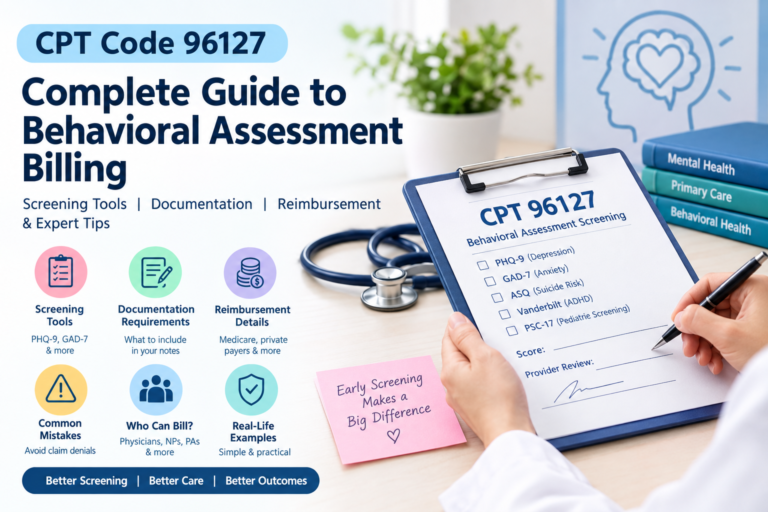
Proper medical billing is a critical part of any healthcare practice. One CPT code that providers use to report services related to the identification and recognition of behavioral and emotional problems is CPT 96127.
As the healthcare landscape continues to evolve, the importance of screening tests for depression, anxiety, and other behavioral conditions becomes increasingly significant.
In this article, we will discuss the details about CPT code 96127 – what it stands for, when to bill it, documentation requirements, reimbursement, common mistakes, and much more.
What Is CPT Code 96127?
CPT Code 96127 Definition
“Brief emotional/behavioral assessment (e.g., depression, inventory, attention-deficit/hyperactivity disorder [ADHD] scale), with scoring and documentation, per standardized instrument.”
Key components
Healthcare providers use CPT code 96127 only for screening (not diagnosis). It uses standardized assessment tools, includes scoring and documentation and multiple billings per visit are possible.
What Does CPT Code 96127 Cover?
CPT code 96127 covers brief behavioral or emotional assessment using standardized screening tools. Healthcare provides use these instruments to usually administer and score during an encounter, taking 5-10 minutes to complete.
Examples of Standardized Screening Tools
- PHQ-9 (Patient Health Questionnaire-9) for depression screening
- GAD-7 (Generalized Anxiety Disorder-7) for anxiety screening
- ASQ (Assessment of Suicide Risk)
- Vanderbilt Assessment Scale for ADHD
- PSC-17 (Pediatric Symptom Checklist)
When to Use Code 96127?
CPT 96127 uses by psychiatrist and physicians to report standardized screening for emotional or behavioral conditions.
Common reasons for using CPT code 96127
Common use of CPT code 96127 is screening of depression in adult patients, anxiety screening in primary care, ADHD screening in pediatric patients, behavioral assessment during well-child visits and screening for substance abuse or suicide risk.
Who Can Bill CPT Code 96127?
Any licensed physician can bill CPT code 96127, including PCPs (Primary Care Physicians), Pediatricians, Psychiatrists, NPs (Nurse Practitioners), PAs (Physician Assistants) and Clinical psychologists.
Billing note:
In some cases, qualified staff (not physicians) can administer the screening tool; however, physician must documents and screen the test.
Billing Guidelines
One of the most important questions regarding CPT code 96127 is how many times providers can bill it. In short, they can report the code multiple times per day, according to the medical necessity and the payer’s policies. Providers typically bill code 96127 at 1-4 units per visit, depending on the situation. Each completed screening tool counts as one unit.
Example
- Completing the PHQ-9 and GAD-7 questionnaires would result in a 2-unit billing of CPT code 96127.
Key CPT Code 96127 Billing Guidelines:
- Use of standardized tools only
- Proper documentation is crucial
- Usage of Modifier 25, when applicable
- Following your payer’s specific policies
Documentation Requirements for CPT Code 96127
Proper documentation is crucial for billing code 96127. Here are the key elements that must include are; name of the Screening Tool (e.g., PHQ-9), Complete Questionnaire in the Medical Record, score (e.g., PHQ-9 Score: 12), Interpretation of Score (e.g., Moderate Depression) and Provider Review and Signature.
Example of Documentation for CPT Code 96127
“PHQ-9 depression screening was performed. The score indicates mild depression. The patient informs about the results and treatment options.”
CPT Code 96127 Reimbursement
The reimbursement for CPT code 96127 can be relatively low per unit (varies by payer). Approximate reimbursement per unit is $3 to $10. By using multiple units we can achieve Higher reimbursement when appropriate.
CPT Code 96127 and Medicare Guidelines
Medicare will cover code 96127 as a mental health screening. However, there are specific Medicare guidelines regarding code 96127 are Code 96127 must be medically necessary, screening should use standardized tools, proper documentation is necessary and there may be frequency limitations.
CPT Code 96127 with Modifier 25
When you report code 96127 together with an Evaluation and Management (E/M) service, you will most likely need to use Modifier 25.
Example:
- Office visit – CPT Code: 99213
- Depression screening – CPT Code: 96127
- Modifier 25 should be added to the E/M code (99213)
Common CPT Code 96127 Billing Mistakes
Avoiding common CPT code 96127 billing mistakes will help you ensure proper reimbursement: Common CPT Code 96127 Billing Mistakes are; using non-standardized screening tools, lack of documentation, billing too many units, failing to use Modifier 25, when applicable and no score documentation.
Comparison Between CPT Codes 96127 and 96130
| Feature | CPT Code 96127 | CPT Code 96130 |
| Full Description | Brief emotional/behavioral assessment (e.g., depression, anxiety screening) | Psychological testing evaluation services by a qualified healthcare professional |
| Type of Service | Screening / Assessment | Comprehensive Evaluation & Interpretation |
| Purpose | Quick screening for mental health conditions | In-depth analysis of psychological test results |
| Complexity Level | Low | High |
| Who Performs it? | Physician, nurse practitioner, or qualified healthcare staff | Clinical psychologist, psychiatrist, or other qualified mental health professional |
| Time Requirement | No specific time requirement (brief) | First hour of evaluation (minimum ~31 minutes) |
| Add-on Codes | Can be billed multiple times per visit if multiple tools are used | Add-on code 96131 used for each additional hour |
| Tools Used | Standardized screening tools (e.g., PHQ-9, GAD-7) | Formal psychological tests, clinical data analysis, patient history |
| Interpretation | Minimal interpretation required | Detailed interpretation and report required |
| Documentation | Simple documentation | Extensive documentation and written report |
| Typical use case | Routine mental health screening in primary care | Neuropsychological or psychological evaluation for diagnosis/treatment planning |
| Reimbursement | Lower reimbursement | Higher reimbursement due to complexity |
| Frequency of use | Common in routine visits | Less frequent, used in specialized evaluations |
Real Life Example:
Office staff report about a 35-year-old patient who is suffering due to fatigue. To diagnose his problem following procedures has been done:
- PHQ-9 questionnaire (depression screening): Score: 15
- GAD-7 questionnaire (anxiety screening): Score: 10
- Billing: Office visit (99213) + CPT Code 96127 × 2
Outcomes:
Healthcare staff identify Depression and anxiety , and establish a treatment plan.
Why CPT Code 96127 Matters in Contemporary Healthcare
Depression, anxiety, and other behavioral conditions are becoming increasingly prevalent in the modern world. Code 96127 helps identify these issues early and allows doctors to provide high-quality treatment.
Benefits of using CPT code 96127:
“CPT code 96127 is beneficial in promoting the early detection and management of mental health conditions; moreover, it improves patient outcomes and increases practice revenue when used correctly.”
Author Note:
Healthcare professionals, medical coder and students will find accurate, up-to-date and practical information about CPT code 96127 in this article.”It explains the correct use of this code for brief emotional and behavioral assessments, including tools like PHQ-9 and GAD-7. Furthermore, our goal is to simplify medical coding concepts while maintaining accuracy based on current CPT guidelines as well as real-world clinical practice.”
Frequently Asked Questions (FAQs)
1. Can providers bill CPT code 96127 multiple times?
Yes, providers can bill code 96127 multiple times per day, according to the physician’s documentation and the payer’s policies.
2. Can insurance covers CPT code 96127??
Yes, in most cases, but it is essential to check with the specific payer.
3. Can a nurse practitioner bill CPT code 96127?
“Yes, nurse practitioners can bill CPT code 96127; however, a registered physician should provide the services.”
4. Does CPT code 96127 require a diagnosis?
No, CPT code 96127 is a screening code and does not require a diagnosis.